Bedrock Just Got a Search Engine: What AWS's New Web Search Tool Means for Your AI Roadmap
By Colin Wood
For two years, the hardest part of putting a large language model to work in a business hasn't been the model — it's been the plumbing around it. Models don't know what happened last week. So teams built retrieval pipelines, stood up vector databases, wrote scrapers, and glued together third-party search APIs just to keep their AI's answers current. Every one of those pieces added cost, latency, and — the part that keeps compliance teams up at night — another place your data leaves your control.
This month, AWS quietly collapsed a lot of that plumbing. Web Search on Amazon Bedrock is a built-in, server-side tool that lets Bedrock models ground their responses in current web knowledge natively — no scraper fleet, no third-party search contract, no data leaving your AWS environment.
And this week AWS expanded it with a small parameter that carries big implications: external_web_access.
Two modes, one governance story
The design is elegantly simple. With external_web_access enabled (the default, gated behind a dedicated IAM permission), Web Search fetches content live from the public web — the right mode when your use case needs the freshest possible information: live pricing, breaking documentation, market conditions as of this morning.
Set it to false, and something more interesting happens: Web Search serves results exclusively from Amazon's own in-AWS web index and knowledge graph, with zero request data leaving the AWS boundary. Your prompts, your customers' data, your retrieval traffic — none of it egresses. For teams in healthcare, finance, defense-adjacent manufacturing, or anyone whose security review has ever died on the words "third-party API," that's not a feature. That's the unlock.
The governance handle is IAM, where your access control already lives — grant bedrock-websearch:ExternalWebAccess to the identities that need live web reach, withhold it everywhere else, and your data-boundary policy becomes enforceable infrastructure instead of a wiki page.
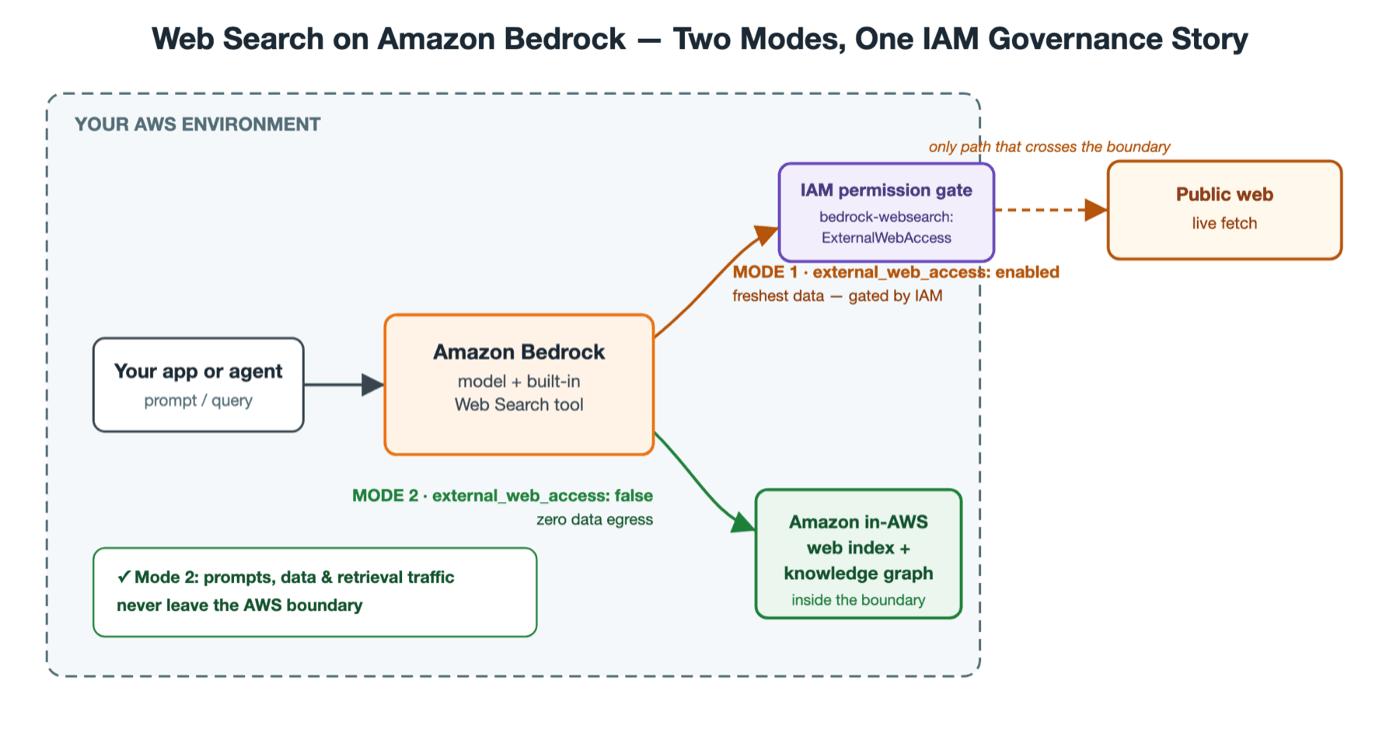
Web Search on Amazon Bedrock: with external_web_access enabled (IAM-gated), results come from a live public-web fetch; set to false, retrieval never leaves the AWS boundary. (Click the diagram to view it full size.)
Why this matters for mid-market teams especially
Enterprises could always afford to build grounding pipelines. The companies this really changes are the ones running lean: the distributor automating purchase-order intake, the logistics firm summarizing carrier updates, the services company whose agents need current regulatory text. Grounded, current, boundary-respecting AI answers just became a configuration decision instead of a quarter-long integration project.
We've been building exactly these Bedrock-based document-intelligence and agentic pipelines for small and midsize businesses — and in that hands-on work, retrieval plumbing has consistently been where budgets and timelines went to die. Native, IAM-governed grounding removes the single most over-engineered component in the stack.
The talent angle
Here's what this shift means for hiring: the skill that matters is moving up the stack. Less demand for engineers who can wire a vector store to a crawler — more demand for engineers who understand IAM-scoped model tooling, agentic orchestration, and data-boundary architecture. Those are rarer skills, and the teams that secure them early will ship faster than the ones still maintaining scrapers.
Put this to work
Building on Bedrock this quarter? Whether you need the architecture built or the team to build it, we can help. Fastwater Cloud.AI designs and builds these Bedrock-based pipelines end to end — and our sister company, Fastwater Cloud Staffing, places engineers at exactly this intersection of Bedrock, agentic AI, and cloud governance. Schedule a consultation and let's talk through what grounding should look like in your environment.